In depth
Mold Remediation in Philadelphia: how the job actually runs.
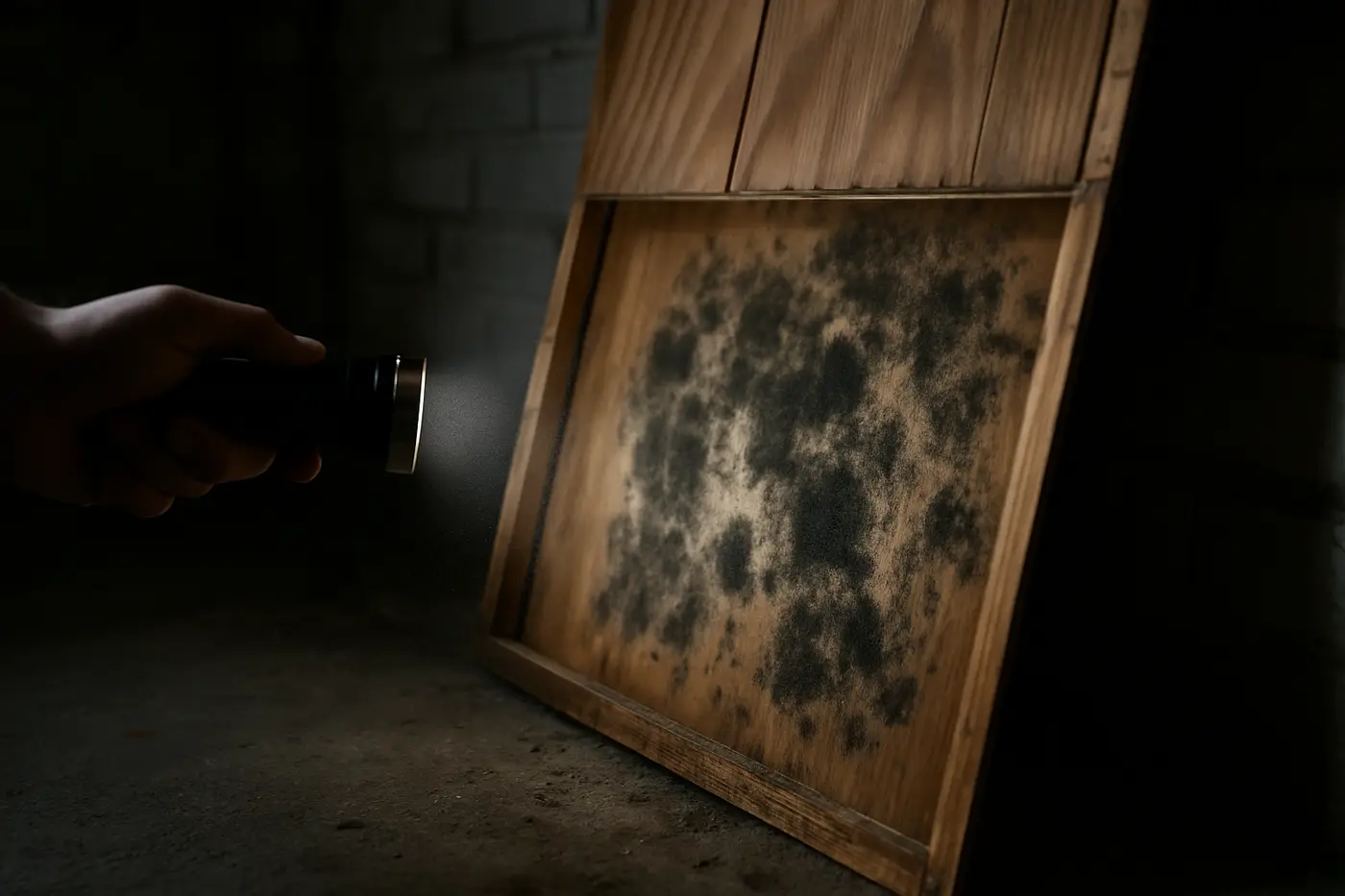
Mold in a Philadelphia rowhome is almost always the second problem. The first was water: a flat roof that let go at a seam, a neighbor’s plumbing leak through the party wall, or a stone-foundation basement that seeps every time a summer thunderstorm sits over the city. Wet drywall paper, lath, joists and cardboard support growth within 24 to 48 hours, and a basement above 60 percent relative humidity from June to September keeps it growing. Mold remediation is the work of correcting that moisture, removing the growth without spreading it, and proving the area is clean before it is closed back up.
Mold remediation and mold removal are the same job
People search for “mold removal” and “mold remediation” as if they were two services. They are not. Removal is one step inside remediation: the porous materials that grew mold come out. Remediation is the whole sequence, from finding the water to verifying the result. A company that “removes” mold by spraying a product over wet drywall has skipped most of the job, and the growth is back within a season. Everything here applies whichever word you use.
What mold remediation involves under IICRC S520
The IICRC S520 standard sets out how mold remediation is done. We follow it on every job, and the order matters.
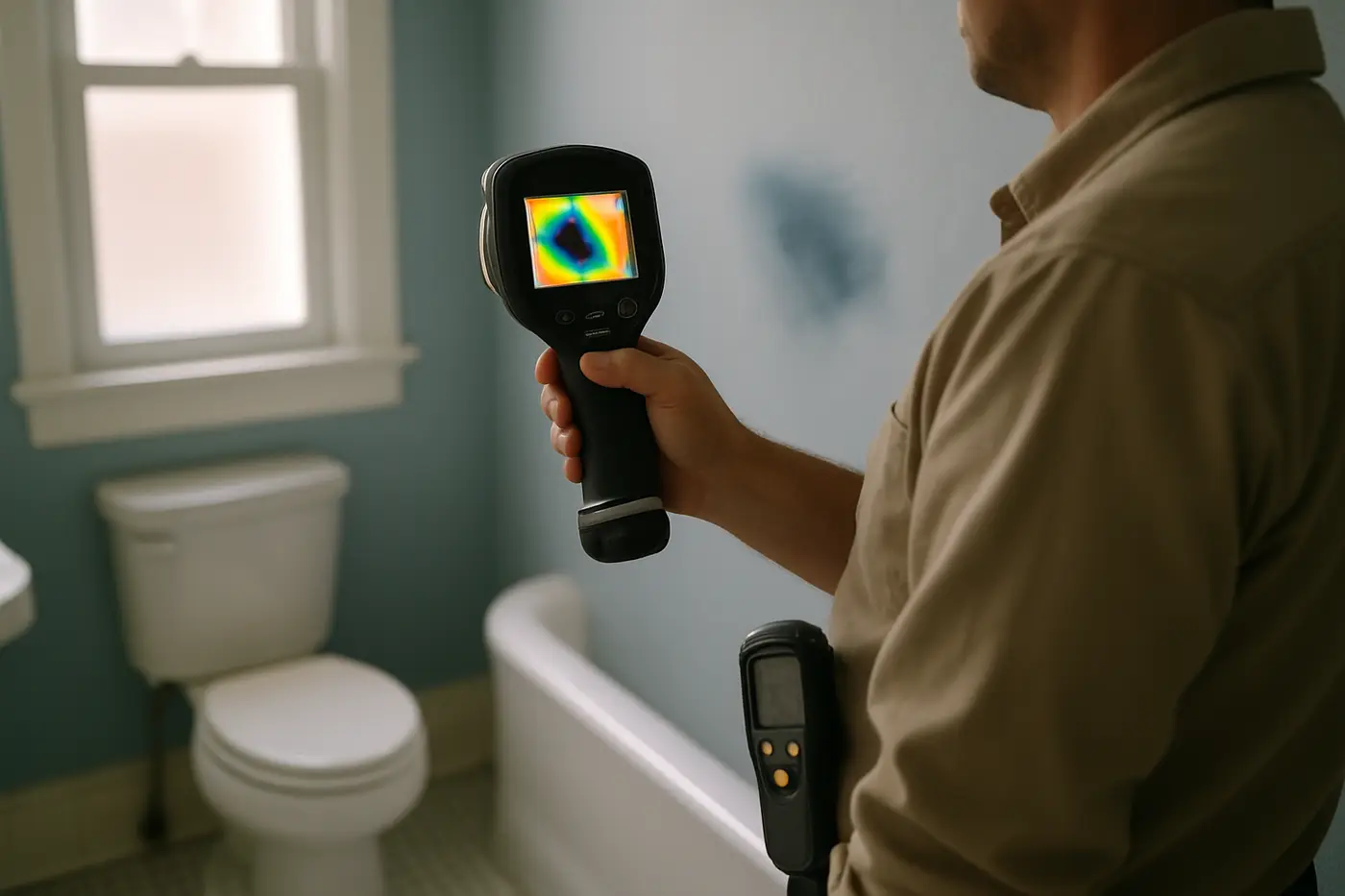
Moisture correction first. We meter walls, floors and joists, check the roof, plumbing, foundation and party wall, and log relative humidity and dew point. A leak gets fixed, a wet structure gets dried, and a damp basement gets dehumidification before any mold work starts.
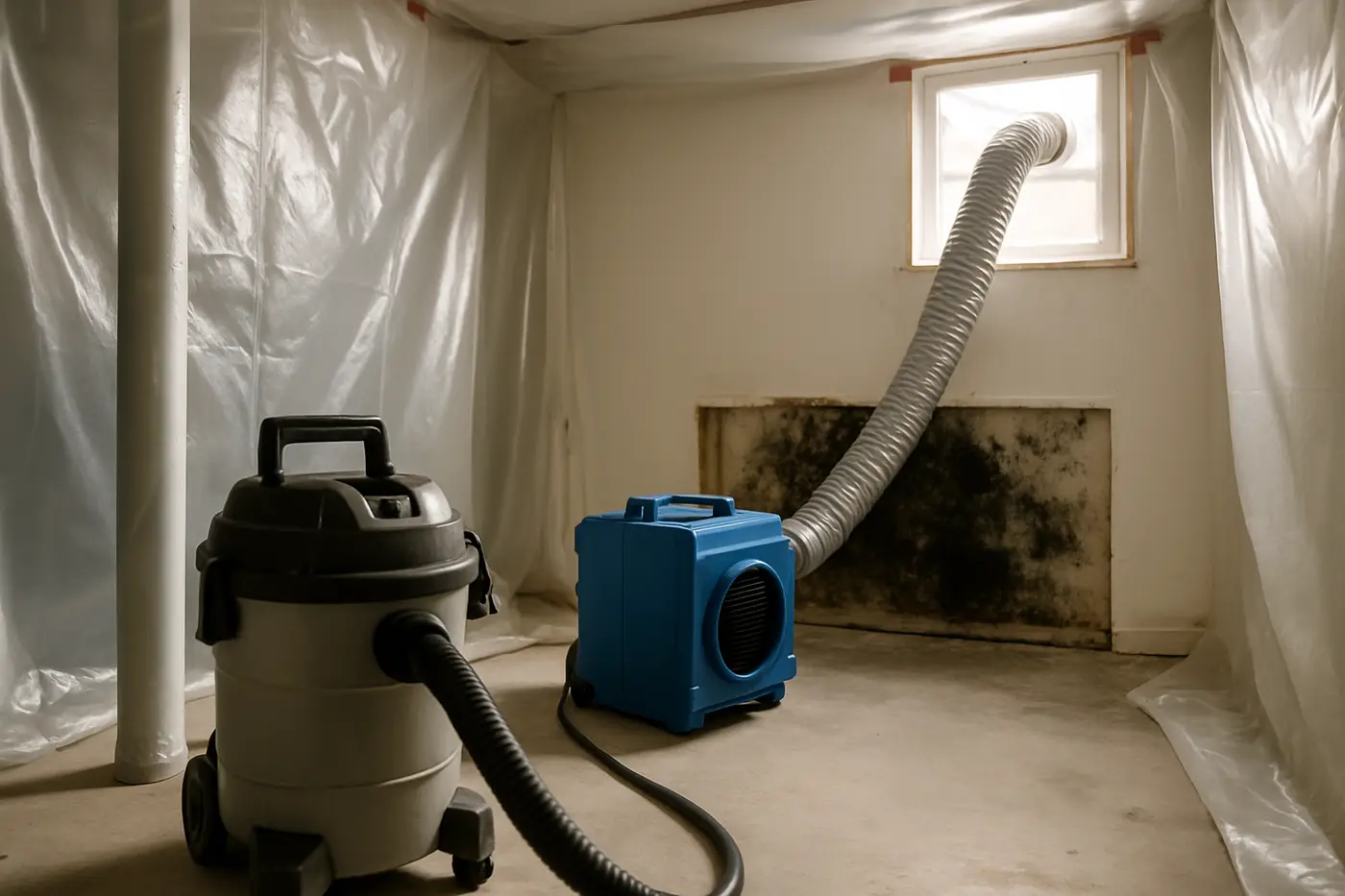
Containment. The work area is sealed with 6-mil poly sheeting and a zippered entry. In a rowhome basement it usually runs from the bottom of the stairs to the affected wall.
Negative air. HEPA-filtered air scrubbers pull air out of the containment, so air moves from the clean side into the work area and never the other way.
Removal. Porous materials with growth are cut out and bagged inside the containment: drywall, soft plaster, paneling, ceiling tile, carpet and pad, insulation, cardboard.
Cleaning. Joists, studs, brick, stone and concrete are HEPA vacuumed, damp wiped and, where growth has penetrated, abraded under negative air. An antimicrobial treatment follows. Bleach is not part of this step; it does not penetrate porous material.
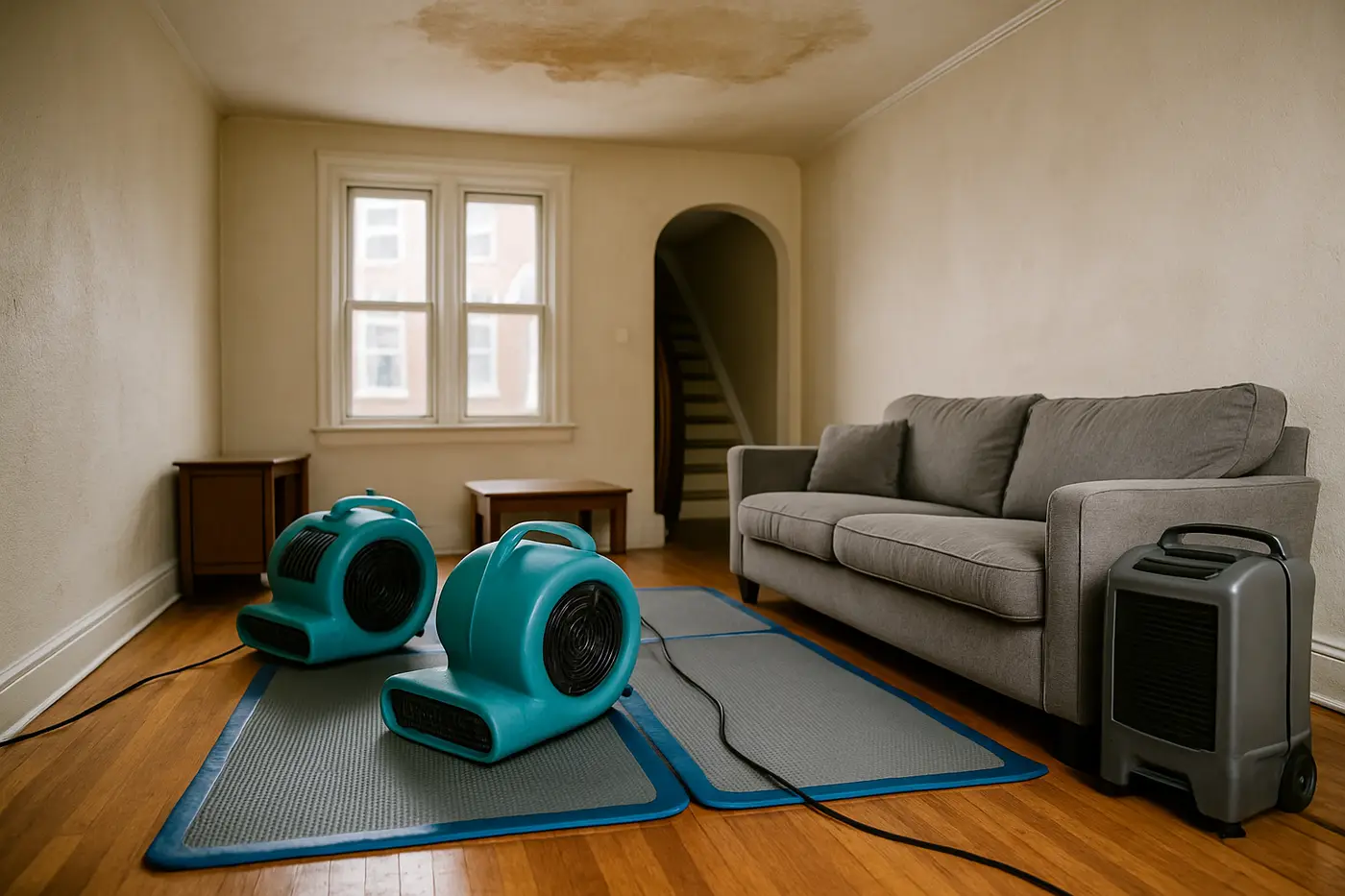
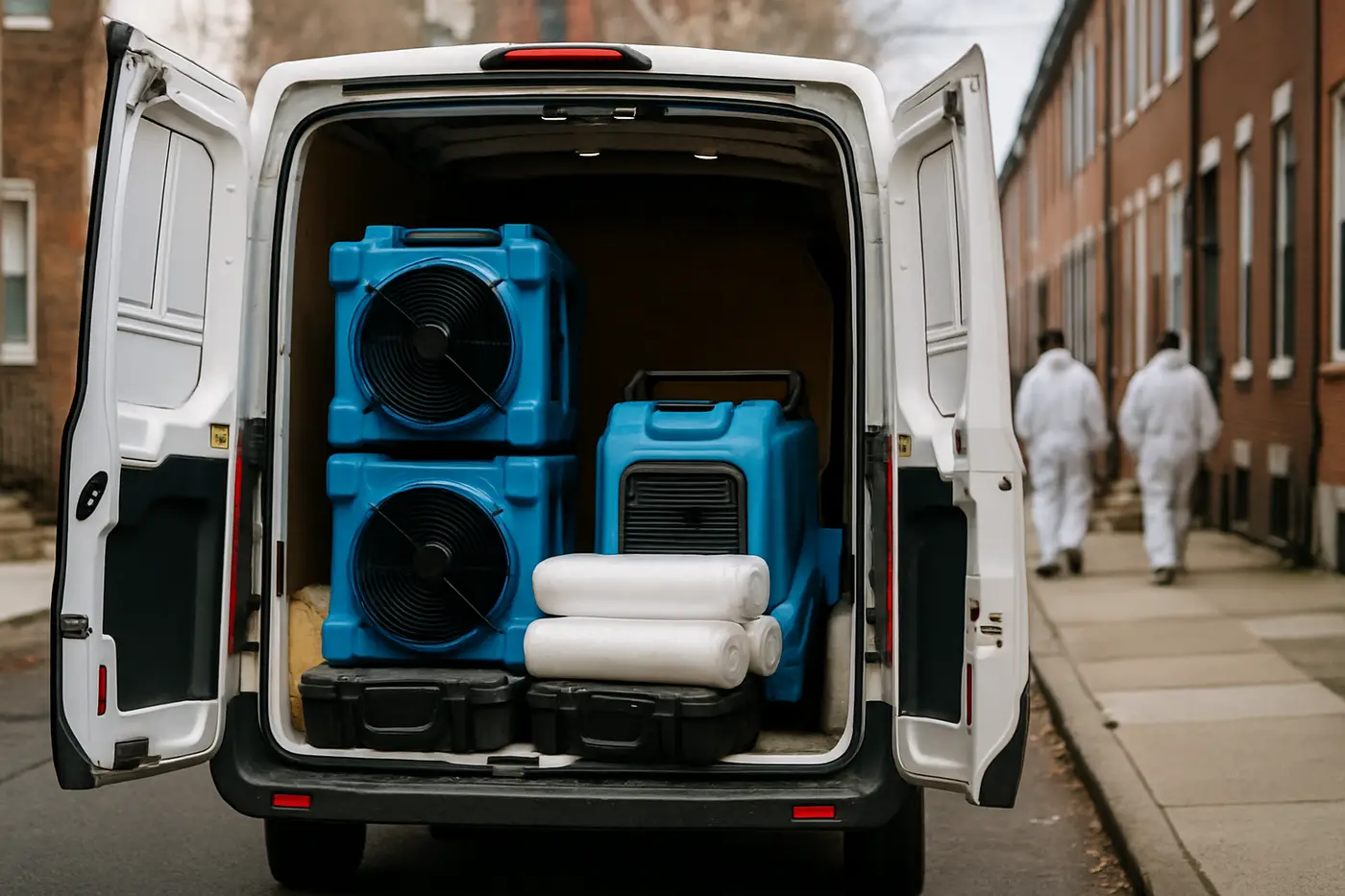
Drying and verification. Air movers and low-grain refrigerant (LGR) dehumidifiers run until every material reads at dry standard, logged daily. Containment comes down only after the area passes verification, described below.
Why the water source has to be fixed first
Killing mold on a surface does nothing about the conditions that grew it. A common Philadelphia example: a silver-coated flat roof that was never recoated opens at a seam during a January freeze-thaw cycle, water runs down inside the rear wall all spring, the owner paints the ceiling stain in May, and by August the plaster is soft and the closet smells musty. The paint covered the visible half of the problem; behind it the lath and the back of the plaster were still above 20 percent moisture content.
That is why remediation starts like a drying job. Moisture readings decide which walls open, how high the cut goes, and which joists are cleaned or replaced. We do not open a wall we have not metered, and we do not close one that has not reached dry standard.
What stays and what goes
The rule under S520 is simple: porous materials with growth are removed; non-porous and semi-porous materials are cleaned in place.
| Material | Usually cleaned and kept | Usually removed |
|---|---|---|
| Drywall | Only when growth sits on the paint film and the back is dry | Growth through the paper facing, or wet more than 48 hours |
| Plaster and lath | Sound, dry plaster can be cleaned; lath is cleaned in place | Plaster that is soft, crumbling or detached from the lath |
| Carpet and pad | Rarely; carpet only after clean water and drying within 48 hours | Any visible growth, any sewer or Category 3 water |
| Batt and blown insulation | No | Always when wet or moldy |
| Joists, studs and subfloor | Yes: HEPA vacuum, damp wipe, abrade, antimicrobial | Only when rotted or structurally compromised |
| Brick, stone and concrete | Always cleaned in place | Never |
| Cardboard, paper, ceiling tile | No | Always |
Rebuilding what was removed is a separate scope; see mold damage repair and rebuild.
Where mold grows in Philadelphia rowhomes
Philadelphia is a rowhome city: brick, built between the 1880s and 1940s, with shared party walls, a flat or low-slope roof and a basement under nearly every house. Each feature feeds mold in its own way.
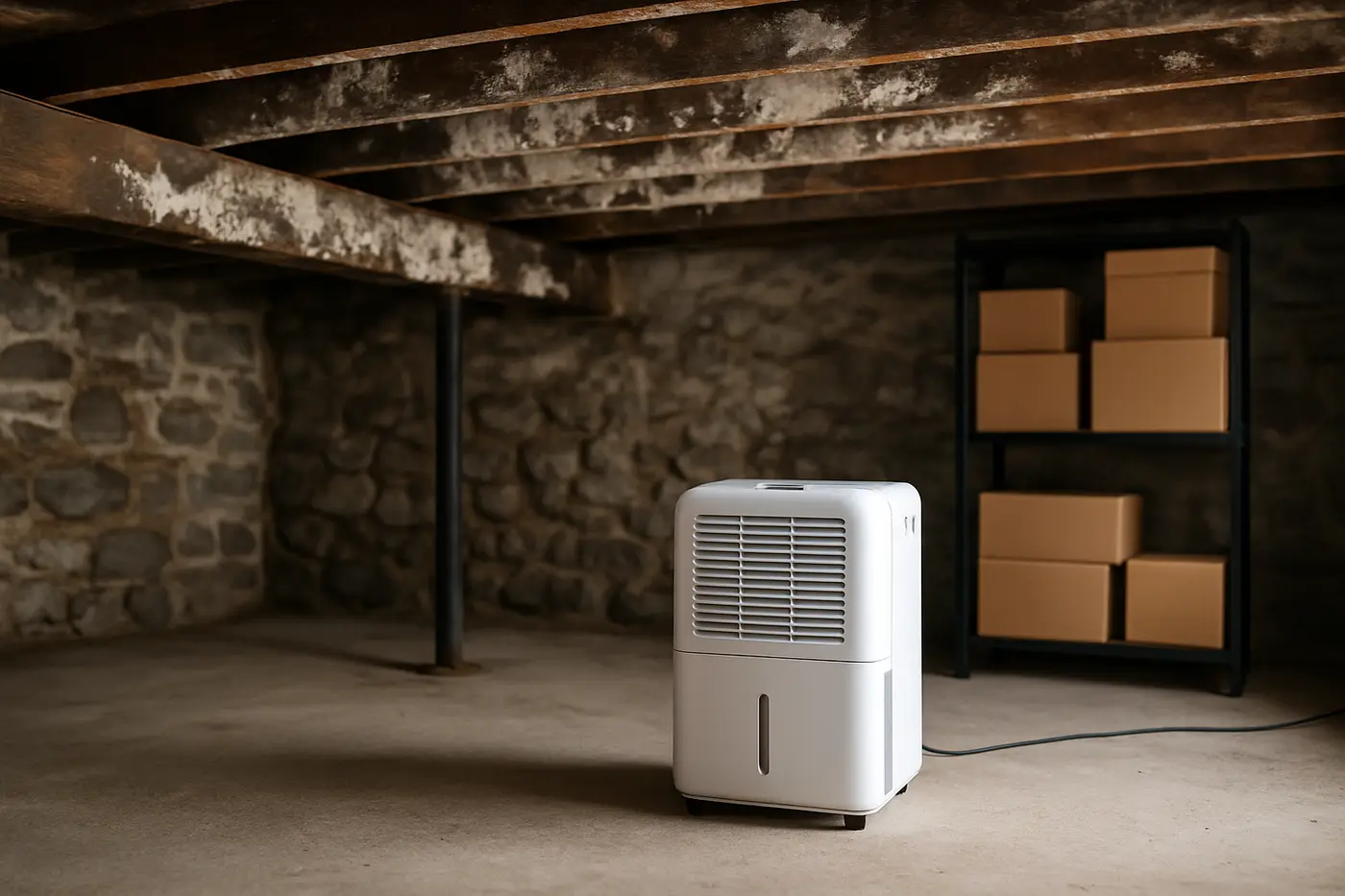
- Stone and rubble basements. Older basements in Queen Village, Fishtown and Germantown sit on stone foundations with unsealed concrete or dirt floors. Ground moisture comes through the walls and slab, and in July and August, when dew points run 65 to 75 degrees F, humid air condenses on the cool stone. See basement mold remediation.
- Flat roofs. Seams, parapets and drains fail after years without recoating, and winter freeze-thaw opens them further. Mold shows up in a top-floor closet or on a bedroom ceiling. See attic and crawl space mold removal.
- Party walls. A leak from the neighbor’s roof or plumbing wets the shared brick and the plaster on your side. Mold on a party wall often has its source in a house you do not own.
- Combined sewer backups. The Philadelphia Water Department runs a combined sewer system across roughly the older two thirds of the city, and heavy rain can push sewer water up through basement floor drains. That is Category 3 water under IICRC S500: any porous material it touched is removed, not dried. Call 311 to report a backup.
- Bathrooms and kitchens. Exhaust fans that vent into the attic or nowhere, leaking tub surrounds in 1950s bathrooms, and slow drips under sinks. See bathroom and kitchen mold removal.
- Multi-unit conversions. In University City student rentals and Old City condo conversions, an upper-unit leak travels down the shared wall cavities, and every unit below belongs in one report.
We work across the city, from Rittenhouse Square to Mayfair and Manayunk.
Testing and post-remediation verification
The EPA’s guidance is direct: if you can see or smell mold, sampling is generally unnecessary, and there is no federal standard for an acceptable airborne mold level. Testing earns its place when mold is suspected but hidden, when a physician wants documentation, when a landlord, tenant, buyer or condo association disputes the scope, and for clearance after the work. For clearance we recommend an independent hygienist so the person reading the results has no stake in them. Our mold inspection and testing page explains both options.
Before containment comes down, the work area is checked against three criteria: no visible growth, dust or debris on any surface, including the tops of joists and inside wall cavities; moisture readings at dry standard against an unaffected reference area; and no musty odor. If any check fails, the area is recleaned and rechecked.
Insurance and documentation in Pennsylvania
A standard HO-3 homeowners policy covers sudden and accidental water losses: a burst pipe, a failed water heater, storm damage that opens the roof. Mold that follows a covered loss is usually paid under a mold sublimit, commonly $5,000 to $10,000, so check your policy. Mold from long-term leaks, seepage, humidity or neglected maintenance is generally excluded, and sewer backup needs a water backup endorsement. Fast, documented drying keeps mold inside the claim. We provide dated photos, moisture logs, a written scope and, for larger losses, an Xactimate estimate. Read does homeowners insurance cover mold in Pennsylvania.
Pennsylvania has no statewide mold license, so the standard a company follows and the documentation it hands you are your protection.
What drives the cost of mold remediation in Philadelphia
A small contained area under 10 square feet, such as a bathroom ceiling or a closet corner, runs $500 to $1,500. A single room is $1,500 to $4,000. A rowhome basement is $2,000 to $8,000, and whole-house or multi-room work starts at $10,000. An inspection with moisture mapping is $250 to $500, credited against the remediation. Independent clearance testing adds $300 to $700. The full table is on our pricing page, and the 2026 cost guide explains what moves a job from the low end to the high end.
The drivers are the size of the affected area, how far growth has penetrated, whether the water was clean or Category 3, how much drying the structure needs, and how much rebuilding follows. The one you control is time: a basement dried within 48 hours is a drying job; the same basement dried in three weeks is a remediation job. If you can see or smell mold in your Philadelphia home, call us or send the form for a visual inspection and a written scope. Not sure whether the smell is mold? Read how to spot hidden mold in a rowhome.
Last updated September 08, 2026