- #home-inspection
- #buying
- #selling
- #disclosure
- #rowhome
- #philadelphia
Mold on a Philadelphia home inspection report is common, especially in a rowhome with a stone basement, and it rarely has to kill the deal. The buyer orders a mold inspection with moisture mapping to size the problem, the parties negotiate a remediation or a credit, and the work is verified with independent clearance testing before closing.
This guide walks through what the home inspector’s note actually means, why stone-basement rowhomes flag so often, what sellers should expect to disclose, how the negotiation usually goes, and what a proper scope looks like when the calendar is the inspection contingency.
What a home inspector notes versus a mold inspection
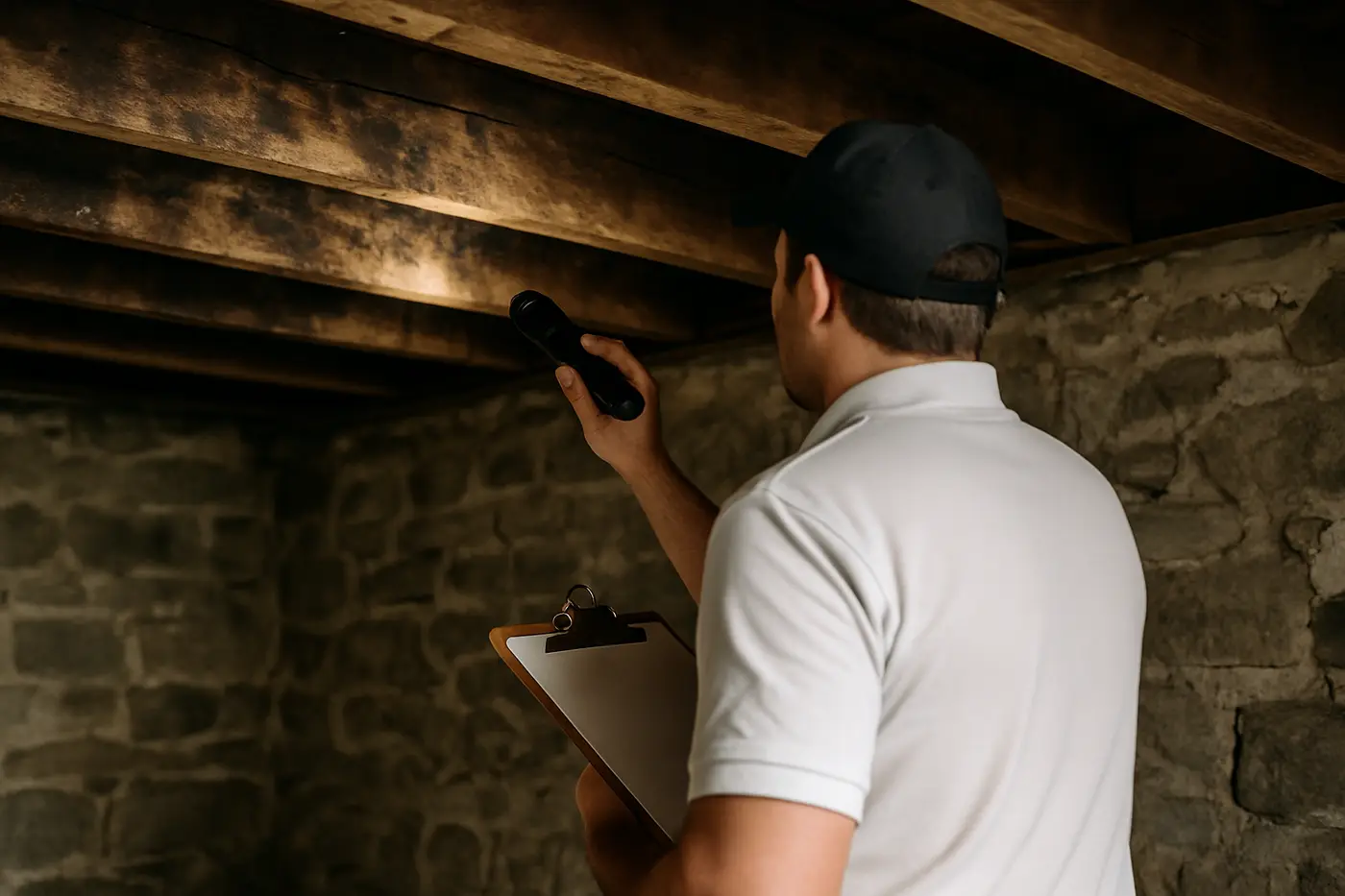
A home inspector spends two to four hours on the whole house: roof, structure, electrical, plumbing, heating, and a visual pass through the basement and attic. The report will use careful language: “staining consistent with past moisture,” “suspected microbial growth on the joists,” “musty odor in the basement,” “elevated moisture readings at the rear foundation wall,” followed by “recommend further evaluation by a qualified specialist.” The inspector is not scoping the mold. They are flagging it.
A mold inspection is the further evaluation. A technician maps moisture through the affected areas with pin and pinless meters and a thermal camera, traces the water to its source, checks behind accessible finishes for how far the growth extends, and writes a scope: what is removed, what is cleaned, how it is contained, how the moisture is fixed and how the result is verified, with an estimate attached. That visit is $250 to $500 and is credited against remediation if you proceed with us. Our mold inspection and testing page explains what the report contains.
Lab sampling is a separate decision. Under EPA guidance, if you can see or smell mold, sampling before remediation is usually unnecessary; the scope is written from the moisture map and the visible extent. Sampling at $75 to $150 per sample earns its cost in two situations: when the odor is there but nothing is visible, and when buyer and seller disagree about extent. Our article on mold inspection versus mold testing covers the distinction in detail.
Why stone-basement rowhomes flag so often
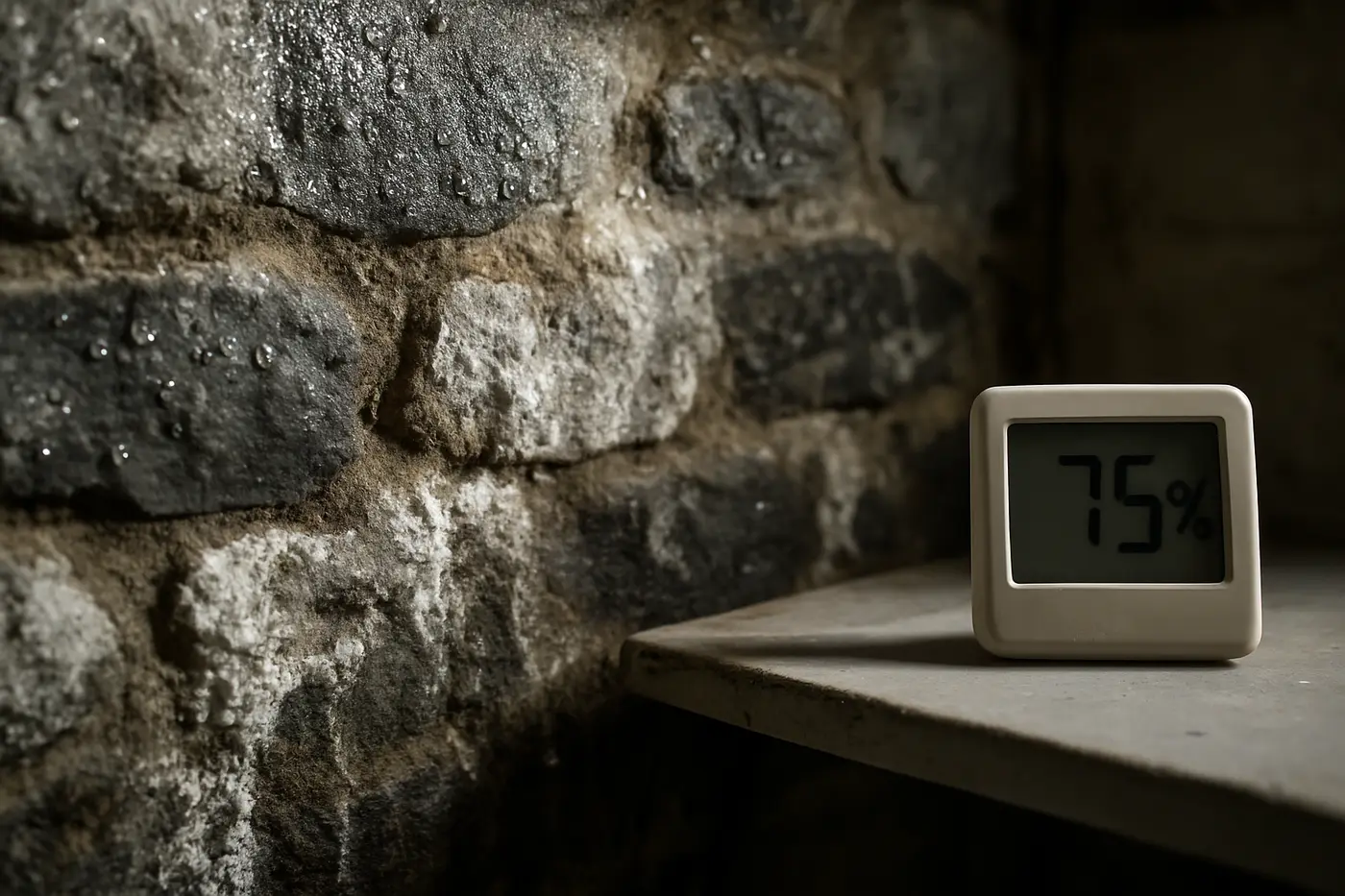
Most of the city’s rowhomes were built between the 1880s and the 1940s, and the older ones sit on stone or rubble foundations over unsealed concrete or dirt floors. Ground moisture comes through all year, summer dew points of 65 to 75 degrees Fahrenheit push basement humidity past 60 percent, and the joist ends rest in pockets in the damp stone. A home inspector who does not note some moisture in a South Philadelphia or Germantown basement is not looking.
Three things on the report deserve a second look before anyone panics.
Efflorescence is not mold. The white, fuzzy or crystalline deposit on stone and concrete is mineral salt left behind by evaporating water. It tells you water is moving through the wall, which matters, but it is not growth. Mold on stone is rarer than mold on the wood and paper near it.
The joists and the back of the paneling are where growth hides. Dark spotting on the underside of the first-floor joists, on the sill plate, and on the back of any paneling or drywall nailed to furring strips against the stone is the typical finding. A finished basement with fresh paint and a running dehumidifier at the showing is worth a careful look behind the finishes.
Freshly painted joists are a flag, not a fix. Paint over growth hides it for a season. A moisture meter and a look at unpainted areas usually tell the story.
Our guide to why Philadelphia rowhome basements grow mold covers the moisture sources, which is what the scope has to fix if the remediation is going to hold.
What sellers should expect to disclose
In general terms, Pennsylvania’s Seller Disclosure Law requires sellers to disclose known material defects, and that can include water intrusion and mold history. If you know the basement takes water in heavy rain, if you have had a roof or party-wall leak, or if you had mold remediated, expect to disclose it. What counts as known or material in a particular sale is a question for your agent or a real estate attorney; we are remediation technicians, not lawyers.
From our side of the work, two things are worth saying. First, a documented remediation is a selling point. A written scope, an invoice showing the moisture repair, and an independent clearance report tell a buyer they are looking at a fixed problem, and buyers pay for fixed problems more readily than for mysteries. Second, painting over growth and hoping the inspector misses it is a poor bet in a stone basement, and it converts a $2,000 to $8,000 remediation into a trust problem at the negotiating table.
Sellers who want to get ahead of it can order the mold inspection themselves before listing, remediate to the S520 standard, get clearance and hand the file to the buyer’s agent with the disclosure.
Negotiating: remediation before closing or a credit
Once the mold inspection has produced a scope and a number, the parties have four practical options.
| Option | Who controls the work | Upside | Watch out for |
|---|---|---|---|
| Seller remediates before closing | Seller | Done and verified before you own it | Seller picks the cheapest contractor; require S520 scope, moisture fix and independent clearance in writing |
| Credit at closing | Buyer | You choose contractor, scope and timing; combine with renovation | Some lenders cap seller credits; you own the problem from day one |
| Escrow holdback | Both | Work happens after closing but funds are secured | Needs clear release conditions, usually a clearance report |
| Walk away under the inspection contingency | Buyer | Clean exit if the source is structural or the numbers fail | Deadlines; get the mold inspection done early in the window |
Which option fits depends on the size of the job, the lender, and how much the buyer wants to control the work. For a small contained area, a credit is simple. For a full basement with a moisture repair, buyers often prefer to control the work and combine it with the finish they wanted anyway; sellers often prefer to pay a contractor and be done.
Get a written scope and clearance before closing
Whichever way the negotiation goes, the document that protects both parties is the written scope. Pennsylvania has no state mold license, so the standard the contractor follows and the paperwork produced are the buyer’s protection. A scope worth accepting includes:
- The moisture source, named, and the repair included or separately contracted. Remediation without a moisture fix is a temporary result.
- The containment area and negative air, with HEPA air scrubbers running for the duration.
- What is removed (colonized drywall, insulation, carpet pad, paneling) and what is cleaned in place (framing, joists, masonry) by HEPA vacuuming and antimicrobial treatment.
- Post-remediation verification by an independent third-party hygienist, so the tester has no stake in the result.
- A timeline and a price, in writing, before the work starts.
- Transfer of all documents to the buyer at closing: scope, invoices, moisture readings, clearance report.
If the seller’s contractor cannot produce that, ask for a different contractor or take the credit. Our mold remediation page describes each step of the process as we run it.
Typical costs
| Item | 2026 range (USD) |
|---|---|
| Mold inspection with moisture mapping and written report | $250-$500, credited against remediation |
| Air or surface sampling by an independent lab | $75-$150 per sample (3 to 5 samples: $300-$700) |
| Small contained area (bathroom ceiling, closet, window) | $500-$1,500 |
| Single room contained remediation | $1,500-$4,000 |
| Basement mold remediation (rowhome basement) | $2,000-$8,000 |
| Attic mold remediation | $2,000-$7,000 |
| Crawl space mold remediation (with vapor barrier) | $1,500-$6,000 |
| Post-remediation verification (independent clearance testing) | $300-$700 |
| Mold damage repair and rebuild | $1,000-$5,000 per room |
Timelines: a single contained area takes 2 to 4 working days; a basement 3 to 6 working days, plus 5 to 10 days of drying if the structure is wet. Our basement mold remediation page covers the stone-foundation work specifically, and the full list is on the pricing page.
Fitting it inside the contingency window
The inspection contingency is the buyer’s leverage, and it is short. A realistic sequence:
- Days 1 to 2: home inspection flags suspected growth and moisture.
- Days 3 to 5: mold inspection with moisture mapping; written scope and estimate within a day or two of the visit.
- Days 5 to 8: negotiate remediation, credit or holdback; if the seller is doing the work, get the scope and the clearance requirement into the agreement.
- Days 8 to 18: remediation, 2 to 6 working days depending on the area, plus drying if needed.
- Days 18 to 22: independent clearance sampling and lab results.
- Closing, with the full file handed over.
If the window is ten days, that does not fit. Ask your agent early about extending the contingency for the mold inspection, or about closing with a credit or holdback so the work happens on your schedule. What you should not do is let the contingency expire while waiting on a verbal promise.
Key takeaways
- A home inspector flags suspected growth; a mold inspection with moisture mapping ($250 to $500, credited) sizes it and writes the scope.
- Stone-basement rowhomes flag often. Efflorescence is salt, not mold; growth hides on joists and behind paneling.
- Pennsylvania’s Seller Disclosure Law requires disclosure of known material defects, which can include water intrusion and mold history. A documented remediation helps a sale.
- Options are seller remediation, a credit, an escrow holdback or walking away; the written scope and independent clearance protect both sides in every case.
- Most rowhome basement remediations run $2,000 to $8,000 plus the moisture fix and $1,000 to $5,000 per room of rebuild.
- Allow two to three weeks from home inspection to clearance, and get the contingency extended if needed.
If the report on your deal says “recommend further evaluation,” send the form or call us. We schedule inspections around contingency deadlines and the written scope is one your agent, the other side and the lender can all read.